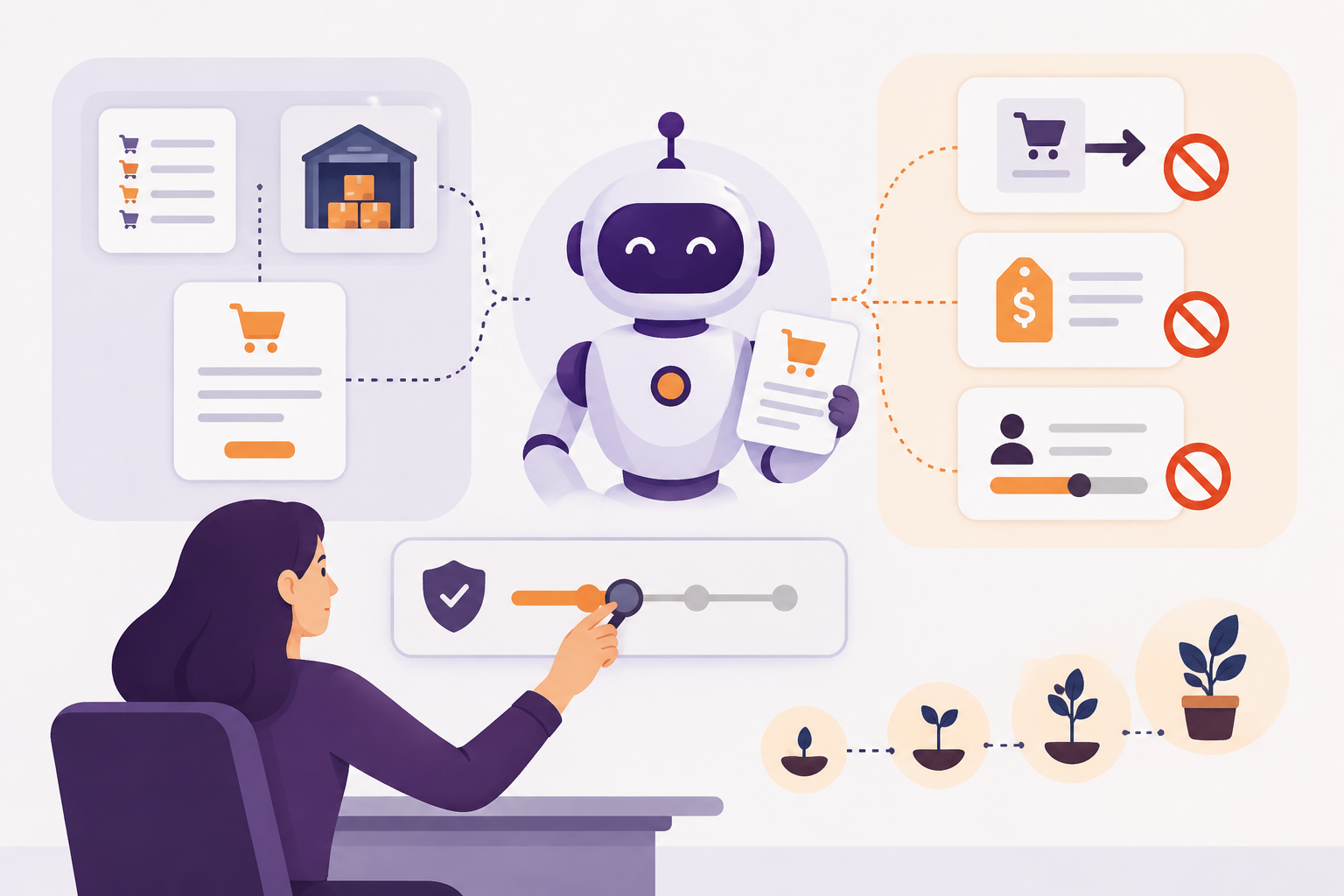
An AI agent that can read your order history, check inventory, and draft a purchase order is useful. An AI agent that can also submit that order, change a price list, or adjust a customer's credit limit is a different kind of risk. The real challenge isn't whether an AI agent can act — it's deciding how much power to give it, and how to prove it deserves more over time.
This article looks at two complementary ideas for managing that risk: three levels of oversight that constrain what an agent can do, and a four-step model for progressively expanding its autonomy.
Three Levels of Oversight
Before an agent is trusted with more autonomy, its scope needs to be narrowed in three distinct ways: how it responds, what it can see, and what it can do.
1. Constrain the response format
An open-ended instruction like "Process this order" leaves too much room for interpretation. Instead, the agent should be required to produce a fixed structure: customer, SKU, quantity, price, PO number, address, requested date. The AI interprets the request; a traditional system then validates the structured output before anything happens.
2. Limit data sources
An agent should only access what it needs for its task, for example:
the approved product catalog
the specific customer's pricing
current inventory levels
that customer's own order history
If the agent can't find an answer, it should say "I don't have that information", rather than guessing or inventing a plausible-sounding answer.
3. Limit actions
Reading information is not the same as acting on it. An agent can be allowed to view data without being allowed to change anything:
Can: Check an account balance — but not modify a customer's credit limit
Can: Prepare an order — but not submit it
Can: Suggest a price — but not edit the price list
The Progressive Trust Model
You don't hand a new employee the keys to the business on their first day. The same logic applies to an AI agent: autonomy should expand gradually, as the agent demonstrates it can be trusted with more.
Step 1 — The AI recommends
The agent analyzes a request and prepares a recommendation; a human makes the decision. At this stage there's no risk of an unwanted action — the AI only suggests.
Step 2 — The AI executes with approval
The agent prepares the order in full; an employee reviews, clicks "Approve" and it's submitted. Manual data entry disappears, but a human keeps the final word.
Step 3 — Automatic processing under thresholds
Once an agent has a track record, some transactions can be processed automatically when they meet defined conditions — for example, an order under $500, from a known customer, for their usual products, with high confidence in the interpretation. Anything outside those thresholds is routed to a human for validation. This is an illustrative example of a threshold rule, not a fixed standard.
Step 4 — Supervised automation
At the most mature stage, the agent works independently on certain tasks, but never in a black box. Four safeguards stay in place:
Logging: every action the agent takes is recorded
Detection: anomalies are flagged automatically
Thresholds: certain cases still trigger human validation
Recovery: a human can take back control at any time
You don't give an AI agent the keys to the business on day one. You increase its autonomy as it proves its reliability. The work doesn't necessarily disappear — it shifts from data entry to oversight.
Together, these two frameworks — oversight that narrows what an agent can see and do, and a trust model that expands its autonomy step by step — are what make it possible to put AI agents to work on real B2B tasks without losing control of the business. The next article looks at the data security layer that makes this enforceable: why an AI agent should never have direct access to everything, and the role of a data hub in deciding what it can read, change, and act on.